
Why Dryer Vent Cleaning Prevents House Fires: What Every Homeowner Must Know
The Hidden Fire Risk in Your Laundry Room
Dryer vent cleaning isn’t glamorous, but it might be the most important safety job you’ll skip this year. The National Fire Protection Association found that failure to clean the dryer was the leading factor in one-third (33%) of home fires involving clothes dryers (data period: 2010-2014). That’s not a freak accident. That’s a preventable crisis we see over and over.
Between 2010 and 2014, U.S. fire departments responded to an estimated 15,970 home fires per year involving clothes dryers or washing machines. Those fires resulted in annual averages of 13 civilian deaths, 440 civilian injuries, and $238 million in direct property damage.
We work in the St. Louis metro area and serve numerous neighborhoods throughout the region. We can tell you that almost every home we visit has a dryer. The real question is whether that dryer vent is already a fire hazard.
This article explains exactly how lint becomes a fire risk, what NFPA 211 calls for regarding dryer vent maintenance, and what you can do today to eliminate the danger. Already concerned? Head straight to our Dryer Vent Cleaning service page — or keep reading to understand what’s actually at stake.
How Lint Buildup Becomes a Fire Hazard
Lint is highly combustible. Period. Your dryer produces it by the basketful with every load of laundry — microscopic fibers that shed from every garment. The lint trap catches only a portion of it. The rest travels into the duct and stays there.
Over months and years, that lint coats the duct walls, narrows the airflow pathway, and creates an insulating layer around a passage that regularly carries hot exhaust air. When restricted airflow forces the dryer to work harder and run hotter, that accumulated lint ignites.
Here’s what we’ve learned from the fires we’ve investigated:
- Lint ignites easily — it’s the same fine, dry fiber people use as fire-starting tinder
- Restricted airflow traps heat inside the duct and the dryer’s heating element
- Longer dry times signal buildup — and also mean more heat cycling through a narrower duct
- Duct bends and elbows collect lint faster than straight runs, creating localized blockages
- Exterior vent caps can partially close or clog, further trapping heat
NFPA 211 states that clothes dryer exhaust must be directed to the outside of the building — not into a wall cavity, attic, or crawl space. When vents are clogged or disconnected, that hot, lint-laden exhaust has nowhere safe to go.
For more on related fire risks in your home’s venting systems, read our chimney sweeping guide on fire prevention and home safety.
When Dryer Fires Are Most Likely to Happen
Dryer fires aren’t random. They follow a pattern we track closely. According to USFA data (2008-2010), dryer fire incidence peaks at 11% in January — the single most dangerous month of the year for dryer-related fires.
January isn’t coincidence. That’s when St. Louis families wash the heaviest fabrics — thick blankets, flannel sheets, fleece jackets — all of which shed more lint per load than lightweight summer clothes. Laundry cycles pile up. Dryers work harder and longer. And if a vent hasn’t been cleaned since spring, months of accumulated lint are sitting there waiting to ignite.
NFPA 211 addresses maximum duct length for dryer exhaust and specifies that each bend in the duct reduces the effective allowable length. Longer ducts with multiple bends — common in older St. Louis homes — accumulate lint faster and restrict airflow more severely. We see this all the time.
If you haven’t scheduled dryer vent cleaning before winter, you’re running the highest-risk months with the highest-risk conditions. Don’t start January unprepared.
What NFPA 211 Says About Dryer Vent Safety
NFPA 211 includes specific, detailed provisions for dryer vent installation and maintenance — and they exist because the fire risk is well-documented. We’ve seen homes that violate these standards, and we’ve seen the consequences. Understanding these provisions helps you recognize when your system is already out of compliance.
Key provisions that directly affect fire risk:
- Dryer exhaust must vent directly to the exterior of the building. Venting into a chimney, shared vent, or interior space is a code violation and a serious fire hazard.
- Dryer ducts must not connect to any chimney or vent system. This is a critical safety boundary — mixing dryer exhaust with a chimney flue creates dangerous backdraft and fire conditions.
- Duct construction must use smooth interior surfaces to minimize lint adhesion. Flexible foil or plastic transition ducts — common in older installations — trap lint at every corrugation.
- Transition ducts connecting the dryer to the wall duct must meet specific standards. Many homes still use undersized or unapproved transition ducts that crush easily and restrict airflow.
- Screws or fasteners must not penetrate the interior of the duct, as they catch lint and accelerate buildup.
If your home has a flexible foil duct, multiple sharp bends, or a vent that hasn’t been inspected in years, you’ve got a compliance problem — and a fire risk to match.
The Energy and Appliance Cost of a Clogged Vent
A clogged dryer vent doesn’t just raise your fire risk — it costs you real money every month. Industry estimates suggest that a restricted vent can increase your dryer’s energy consumption by up to 30 percent. Every load costs more than it should. Your utility bill climbs without explanation.
And that’s not all. When a dryer can’t exhaust heat efficiently, its components take constant thermal stress — the heating element, thermostat, motor, drum seals. A dryer that should last 10 to 15 years may fail in 5 to 7 years if the vent is chronically restricted. We’ve seen it countless times.
Replacing a dryer costs hundreds to over a thousand dollars. Annual dryer vent cleaning costs a fraction of that — and eliminates both the premature failure risk and the energy waste at the same time.
There’s also a moisture problem. When humid exhaust air can’t escape properly, it backs up into the laundry room and adjacent spaces. The EPA identifies excess moisture as the primary factor in indoor mold growth, and a chronically damp wall cavity behind your dryer is exactly the kind of hidden damage that’s expensive to fix later.
See our full breakdown in 7 Major Risks of Not Getting a Dryer Vent Cleaning.
What Professional Dryer Vent Cleaning Actually Involves
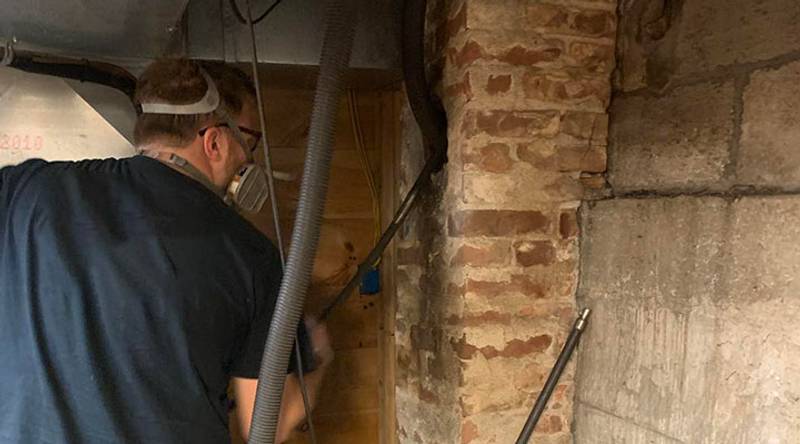
Professional dryer vent cleaning goes far beyond emptying your lint trap. The lint trap catches only a portion of what your dryer produces. The rest travels into the duct — and that’s where professional service actually matters.
Here’s what our technicians do during a cleaning:
- Disconnects the dryer from the duct at the transition connection to access the full system
- Inspects the duct for damage, kinks, improper materials, and code compliance issues
- Uses a rotary brush system to break up and dislodge lint from the full length of the duct, including all bends and elbows
- Clears the exterior termination cap, removing any accumulated lint, debris, or bird nesting material that’s blocking airflow
- Verifies proper airflow after cleaning to confirm the system is performing correctly
- Reconnects the dryer and checks that the transition duct is properly seated and undamaged
NFPA 211 notes that clothes dryers must have a lint collector — but the standard’s broader maintenance provisions make clear that lint management is ongoing, not a one-time installation task. The standard calls for annual inspection of venting systems to ensure they remain free from deposits and obstructions.
We also look for the conditions that cause fast lint accumulation: kinked flexible ducts, oversized duct runs with too many bends, damaged exterior caps, and improper duct materials. Fixing these issues means your vent stays cleaner longer between service calls.
Homeowners throughout the St. Louis area can schedule service with us — we serve the entire metro region from our base in Woodson Terrace, MO.
Schedule Your Dryer Vent Cleaning Today
Waiting to clean your dryer vent isn’t neutral. Every week you delay is another week of lint accumulating in a duct that carries heat, sparks, and combustible exhaust air. Failure to clean is the leading factor in one-third of dryer fires — and those fires destroyed millions of dollars in property and injured hundreds of people every year.
Don’t let your home become a statistic. We serve homeowners throughout the greater St. Louis metro area. We’re licensed and insured, and we donate 10% of every dollar we earn to charity. Military personnel, first responders, fixed-income households, and non-profit organizations receive a 10% discount on all services.
Call us today at (314) 322-7122 to schedule your dryer vent cleaning — and stop risking a preventable fire in your home.

Joshua Scalf
Owner, Friendly Fire LLC
Joshua Scalf is the owner and lead technician at Friendly Fire LLC, bringing over 6 years of chimney service expertise to the greater St. Louis area.
Frequently Asked Questions
How often should I get my dryer vent cleaned?
Can I clean my dryer vent myself, or do I need a professional?
What are the signs that my dryer vent needs cleaning?
Is dryer vent cleaning really necessary for homes in the St. Louis area?
How much does dryer vent cleaning cost, and is it worth it?
Need Chimney Service?
Don't wait until a small problem becomes an expensive repair. Friendly Fire serves the greater St. Louis area with honest, affordable chimney services.
Licensed & insured · 10% donated to charity · Military & first responder discounts
Related Articles
Gas Fireplace vs Wood Burning: Pros, Cons, and Which Is Right for Your Home
Choosing gas vs wood fireplace? Discover the real costs, safety risks, and maintenance demands before making a decision you'll regret for years.
Chimney Inspection Levels Explained: Level 1, 2, and 3
Don't guess which chimney inspection you need. Learn the difference between Level 1, 2, and 3 inspections—and what you risk by skipping the right one.
How Often Should You Get Your Chimney Swept? The Complete Homeowner's Guide
Don't risk a chimney fire this season. Learn exactly how often you should get your chimney swept based on fuel type, usage, and NFPA 211 guidelines.