
Creosote Buildup: What Every Homeowner Should Know
What Creosote Buildup Actually Is
Creosote buildup is the single greatest fire hazard inside your chimney — a flammable, tar-like byproduct of wood combustion that coats your flue liner with every fire you build. It forms when smoke, gases, and unburned wood particles cool and condense against the inner walls of your chimney. Left unchecked, it becomes one of the most dangerous substances in your home.
The Chimney Safety Institute of America (CSIA) identifies creosote buildup as the primary cause of chimney fires in the United States. With approximately 25,000 chimney fires occurring each year nationwide, this isn’t theoretical risk — it’s a statistical certainty for homeowners who skip annual maintenance.
If you’re burning wood in a St. Louis fireplace right now, creosote is forming in your chimney. The only question is how much, and how dangerous it’s gotten.
Understanding what creosote is — and how fast it progresses — is the first step toward protecting your home and your family. That’s exactly why our chimney sweeping service exists. We remove it before it reaches a dangerous level.
The 3 Stages of Creosote (And Why Stage 3 Is Terrifying)
Creosote progresses through three distinct stages, each more dangerous and harder to remove than the last. Which stage you’re in determines both how fast you need to act and what method I’ll use to fix it.
Here’s what you’re looking at:
- Stage 1 — Light, flaky, dust-like soot. Standard brushing handles it easy. Low immediate fire risk, but it doesn’t stay Stage 1 forever.
- Stage 2 — Dense, shiny, tar-like coating. Significantly harder to remove. Requires specialized tools and professional-grade techniques.
- Stage 3 — Thick, hardened, glazed deposits. Extremely difficult to remove. This is the stage that kills people.
Stage 3 creosote is hard to clean. But it’s also structurally dangerous. Stage 3 glazed creosote can auto-ignite at temperatures as low as 451 degrees Fahrenheit — which is well within the range of a normal fireplace fire. You don’t need an unusually hot burn. You don’t need a spark. Just a Tuesday night fire in December and enough buildup on your flue walls, and you’re in trouble.
At that point, you’re not lighting a fireplace. You’re lighting your chimney.
The National Fire Protection Association (NFPA) found that failure to clean chimneys and flues was a factor in 68 percent of home structure fires involving fireplaces, chimneys, or chimney connectors. That’s not some obscure statistic. That’s a pattern of entirely preventable disasters.
What Causes Creosote to Build Up Faster
Creosote accumulates faster when combustion is incomplete — and several common habits dramatically accelerate how quickly it progresses from Stage 1 to Stage 3. You’ve got control over your risk here.
The biggest contributors to rapid buildup include:
- Burning green or unseasoned wood — Green wood contains 40 to 60 percent moisture content. Your fire wastes enormous energy just evaporating that water before any real combustion occurs. The result is dense, cooler smoke packed with creosote precursors.
- Low, smoldering fires — A small, slow-burning fire produces more smoke and less heat. That cooler smoke condenses faster on your flue liner walls.
- Restricted airflow — A closed damper or poor draft means smoke lingers longer in the flue, giving creosote more time to stick.
- Oversized flues — A flue that’s too large for the firebox cools the exhaust gases too quickly, promoting condensation.
- Cold flue temperatures at startup — Starting a fire in a cold chimney without warming the flue first causes rapid condensation in the early minutes of burning.
Burn properly seasoned hardwood with moisture content below 20 percent. That’s the simplest fix there is. Oak, hickory, and ash work great for St. Louis homeowners. A moisture meter costs under $20 at any hardware store and removes all the guesswork. Want more detail on how burning habits connect to maintenance? Check out our chimney sweeping guide on fire prevention and home safety.
Why Annual Inspections Are Non-Negotiable
You cannot assess creosote levels without looking inside the flue — and that means professional inspection, not guesswork from the firebox opening. Annual service isn’t a sales pitch. It’s the minimum standard set by two of the most respected fire safety organizations in the country.
NFPA 211 states that chimneys, fireplaces, and vents shall be inspected at least once a year for soundness, freedom from deposits, and correct clearances. CSIA echoes this for all fuel types — including gas fireplaces, which produce their own deposits even without traditional creosote.
A professional chimney inspection does more than check creosote levels. CSIA defines three levels of inspection:
- Level I — Standard annual visual inspection of accessible areas. Appropriate for routine yearly service when nothing has changed.
- Level II — Required after a chimney fire, home sale, fuel change, or any significant event. Includes video scanning of the flue interior.
- Level III — Reserved for suspected concealed structural damage. May involve opening walls or chase covers to access the flue system.
Most homeowners need a Level I annually and a Level II after any incident. Skipping even one year allows creosote to progress an entire stage in many cases — and Stage 2 removal costs significantly more than Stage 1 prevention.
Unsure where your chimney stands right now? That uncertainty is itself a reason to call. Homeowners in Florissant, Chesterfield, Maryland Heights, and across the St. Louis metro can reach me at (314) 322-7122.
How Creosote Leads to More Than Just Chimney Fires
Creosote buildup doesn’t stop at fire risk. Heavy deposits restrict your flue, reduce draft, and can force combustion gases — including carbon monoxide — back into your living space.
Carbon monoxide (CO) is colorless and odorless. You cannot detect it without a functioning CO detector. The Centers for Disease Control and Prevention (CDC) reports that more than 400 Americans die from unintentional CO poisoning every year, with more than 100,000 visiting emergency rooms annually. A blocked or restricted flue is one of the leading pathways for CO to enter a home.
Creosote buildup also causes:
- Structural damage to your flue liner — Acidic byproducts in creosote etch clay tile liners over time, creating cracks that allow heat and combustion gases to reach the surrounding masonry.
- Persistent odor problems — Creosote has a powerful, acrid smell that intensifies in warm weather and high humidity — something I hear about constantly from St. Louis homeowners in spring and summer.
- Reduced heating efficiency — A coated flue restricts airflow, which weakens your draft and forces your fire to work harder to maintain combustion.
If your chimney shows structural wear alongside creosote buildup, you may also need masonry repair to restore the integrity of your flue system. Our article on chimney repair warning signs walks you through what to look for on the outside of your chimney.
What Professional Creosote Removal Actually Involves
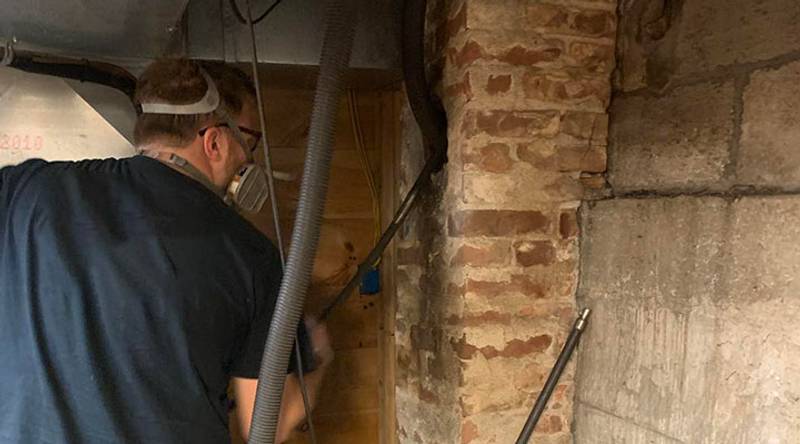
Professional chimney sweeping removes creosote at every stage using tools and techniques matched to how advanced the deposits are. This isn’t a DIY job — and attempting it without the right equipment can spread flammable material and leave dangerous residue behind.
Here’s what I do:
- Protect your home — Drop cloths and a high-powered vacuum seal off the firebox before any cleaning begins. Your living room doesn’t get coated in soot.
- Inspect the flue — A visual or camera-based inspection assesses deposit stage and identifies any structural concerns before brushing begins.
- Remove Stage 1 deposits — Rotary brushes matched to your flue liner size dislodge light soot and flaky buildup. Vacuum suction captures it immediately.
- Treat Stage 2 deposits — Harder tar-like coatings require chemical treatments and specialized rotary tools to break down the glaze before mechanical removal.
- Address Stage 3 glazed creosote — This is a multi-step process involving chemical deglazers applied over multiple visits. In severe cases, liner replacement may be the safest outcome.
Chimney cleaning logs sold at hardware stores help maintain a clean flue between professional services — they don’t replace professional sweeping. They’re a supplement, not a solution.
Regular chimney sweeping keeps you at Stage 1, where removal is fast, inexpensive, and low-risk. Every year you delay moves the deposit closer to Stage 3, where the cost — in dollars and in safety — climbs significantly.
Schedule Your Chimney Inspection Today
Every week you delay is another week of creosote building toward Stage 3 — and Stage 3 doesn’t send you a warning before it ignites. With approximately 25,000 chimney fires occurring in the U.S. each year and failure to clean identified as a factor in 68 percent of fireplace-related home fires, the cost of skipping service is simply too high.
Friendly Fire Chimney serves homeowners throughout the greater St. Louis metro area — from Woodson Terrace and University City to Belleville, Chesterfield, and beyond. We’re licensed and insured, and we donate 10 percent of every dollar in revenue to charity. Military personnel, first responders, fixed-income households, and non-profit organizations receive a 10 percent discount on all services.
Call me today at (314) 322-7122 or schedule online. Don’t wait until you smell smoke from somewhere it shouldn’t be.
Joshua Scalf
Owner, Friendly Fire LLC
Joshua Scalf is the owner and lead technician at Friendly Fire LLC, bringing over 6 years of chimney service expertise to the greater St. Louis area.
Frequently Asked Questions
How do I know if I have creosote buildup in my chimney?
How often should I have my chimney swept to prevent creosote buildup?
Is creosote buildup dangerous even if I haven't had a chimney fire?
What wood should I burn to reduce creosote in my St. Louis area home?
Can I remove creosote buildup myself, or do I need a professional?
Need Chimney Service?
Don't wait until a small problem becomes an expensive repair. Friendly Fire serves the greater St. Louis area with honest, affordable chimney services.
Licensed & insured · 10% donated to charity · Military & first responder discounts
Related Articles
How to Prepare Your Chimney for Winter: A Complete Homeowner's Guide
Don't risk a chimney fire this winter. Learn exactly how to prepare your chimney before heating season — from inspections to creosote removal and masonry…
Chimney Inspection Levels Explained: Level 1, 2, and 3
Don't guess which chimney inspection you need. Learn the difference between Level 1, 2, and 3 inspections—and what you risk by skipping the right one.
Common Chimney Problems in Older St. Louis Homes
Older St. Louis homes hide costly chimney problems. Discover the most common issues—and what you're risking by leaving them undetected—before they become…